


 Bigeasyseo
On-Page SEO Explained: How to Optimize Your Website to Rank Higher on Google


What Is On-Page SEO?
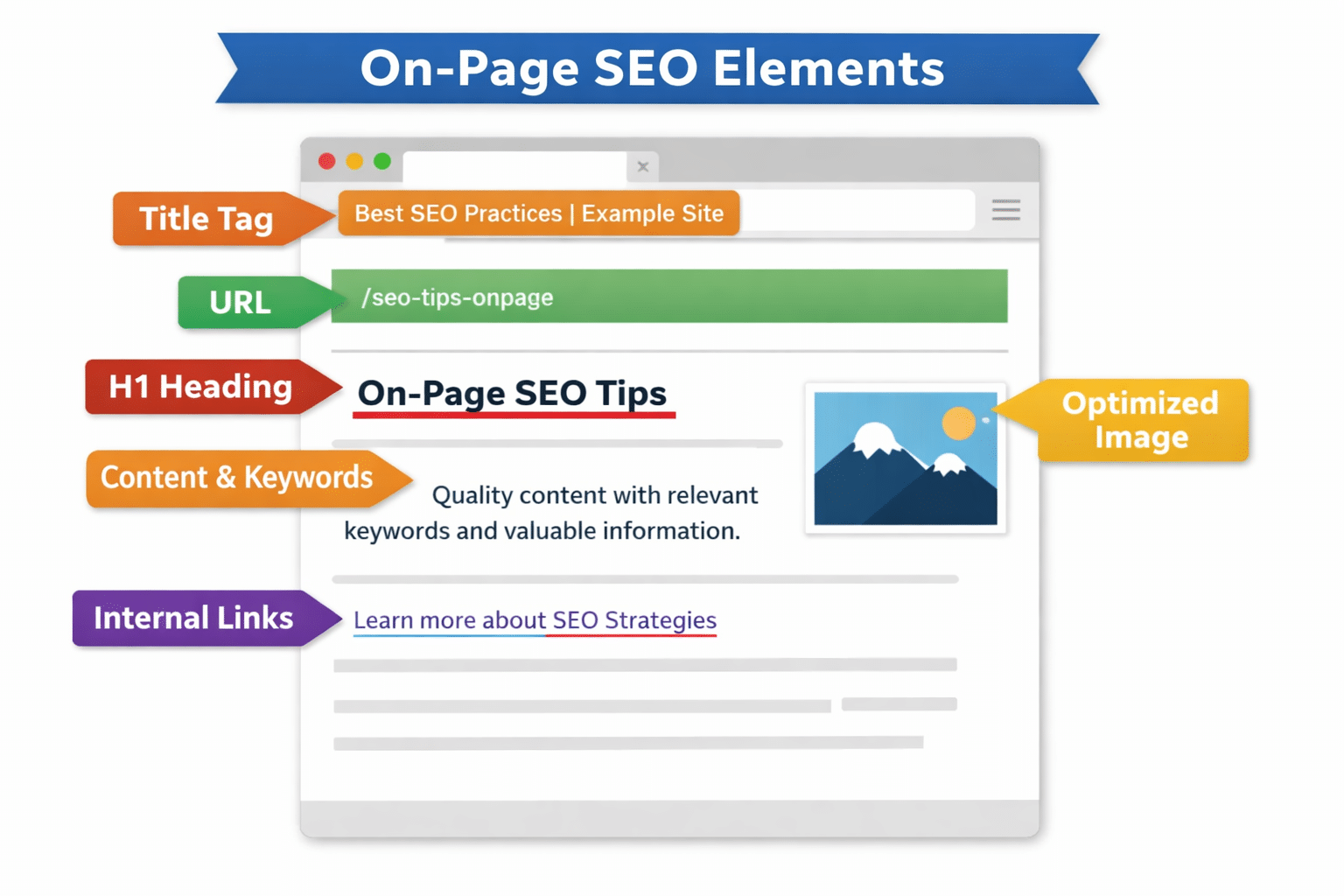
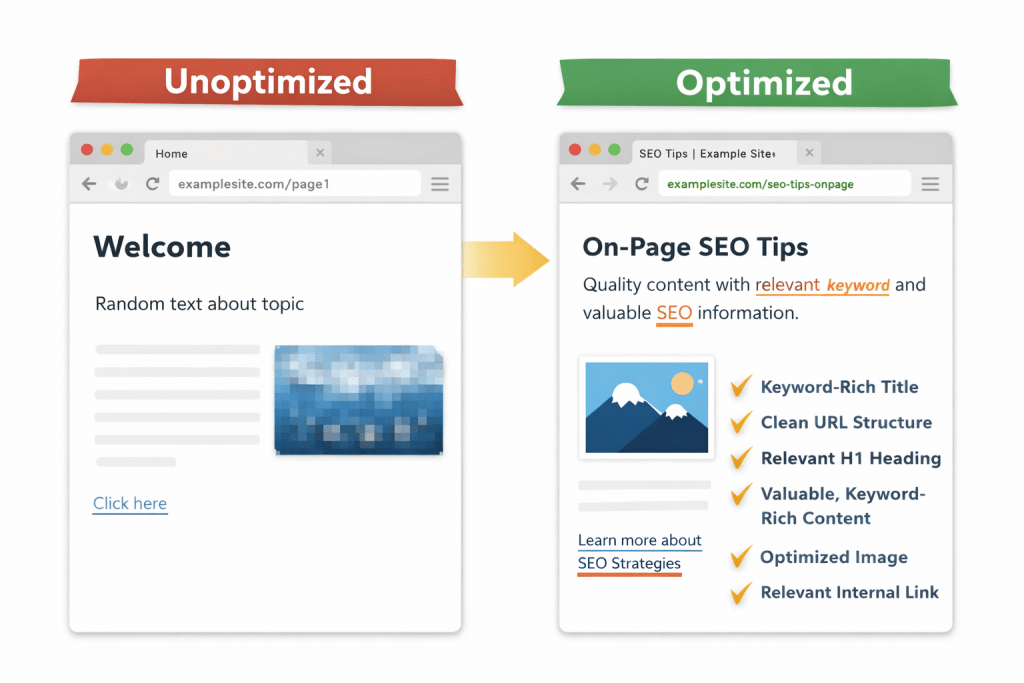
On-page SEO refers to the optimizations you make directly on your website pages to help search engines understand your content and rank it for relevant searches. It includes writing quality content, structuring HTML elements like title tags and headers, building internal links, and optimizing images and URLs.
Think of your website like a storefront. Off-page SEO is the reputation your business has around town, and technical SEO is the plumbing and electrical work behind the walls. On-page SEO is everything a customer sees and interacts with when they walk through the front door. It is the signage, the layout, the product displays, and the staff ready to help. If those elements are disorganized, visitors leave. The same principle applies to your website.
On-page optimization sits between two other branches of search engine optimization. Technical SEO ensures search engines can access and crawl your site. Off-page SEO builds your site’s authority through backlinks and brand mentions. On-page SEO ties them together by making sure every page on your site clearly communicates its topic, matches what your audience is searching for, and delivers a positive experience.
Google processes billions of searches every day. Research consistently shows that the top three organic results capture the majority of all clicks, and fewer than 1% of searchers visit the second page. Ranking on page one starts with getting your on-page fundamentals right.
Why On-Page SEO Matters for Your Business
On-page SEO is one of the most direct ways to increase your website’s visibility in search results. Unlike paid ads that stop producing traffic the moment your budget runs out, on-page optimization builds long-term equity that compounds over time.
It Drives Qualified Traffic
Every page on your website has the potential to attract visitors who are already searching for what you offer. A well-optimized service page, blog post, or location page can rank for specific search queries and bring in people who are actively looking for your products or services. That kind of traffic converts at a much higher rate than cold outreach or generic advertising.
It Builds Long-Term Visibility
Paid advertising delivers fast results, but the returns disappear the second you pause a campaign. On-page SEO works differently. A page that ranks well today can continue generating traffic for months or years with periodic updates. Over time, your investment in on-page optimization pays dividends that grow rather than shrink.
It Strengthens Every Marketing Channel
Strong on-page SEO makes your PPC campaigns more effective by improving Quality Scores and lowering cost-per-click. It gives your social media posts better landing pages to drive traffic toward. It makes email marketing more productive because subscribers land on pages that are organized, relevant, and built to convert. On-page SEO is the foundation that every other digital marketing channel relies on.
Want to see where your website stands? Big Easy SEO offers a free website analysis to identify on-page SEO gaps that could be holding back your traffic. Contact us today to get started.
How to Do Keyword Research for On-Page SEO
Keyword research is the process of finding the specific words and phrases your potential customers type into search engines. Without it, on-page optimization is guesswork. The right keywords connect your pages to real search demand.
Choosing the Right Keywords for Your Pages
Start with your primary services and products. If you run a seafood restaurant in New Orleans, your primary keywords might include “seafood restaurant New Orleans” or “best oysters in New Orleans.” These are the terms that directly describe what your business offers.
From there, expand into secondary keywords and long-tail variations. Long-tail keywords are longer, more specific phrases like “where to get chargrilled oysters near the French Quarter.” They typically have lower search volume but much higher conversion potential because they match a specific need.
Matching Keywords to Search Intent
Every search query has an intent behind it. Someone searching “what is on-page SEO” wants to learn. Someone searching “on-page SEO services near me” is looking for a provider. Google’s algorithms are built to match results to intent, so your content needs to align with what the searcher actually wants.
There are four main types of search intent:
- Informational – The searcher wants to learn something (“how does on-page SEO work”)
- Navigational – The searcher is looking for a specific website or brand (“Big Easy SEO on-page services”)
- Commercial – The searcher is comparing options before making a decision (“best on-page SEO tools for small business”)
- Transactional – The searcher is ready to take action (“hire on-page SEO company New Orleans”)
Matching your page content to the correct intent type is one of the strongest on-page SEO signals you can send. For a deeper walkthrough on finding and organizing the right keywords, explore our guide on keyword research for small business owners.
Optimizing Title Tags and Meta Descriptions
Title tags and meta descriptions are the first things searchers see in Google’s results pages. They directly affect whether someone clicks through to your site or scrolls past it. Optimizing these elements is one of the fastest ways to improve on-page SEO performance.
Writing Title Tags That Rank and Get Clicks
Your title tag tells Google what your page is about and tells searchers why they should click. Best practices include:
- Place your primary keyword near the beginning of the title
- Keep the total length between 50 and 60 characters
- Make each title tag unique across your entire website
- Include your brand name at the end when space allows
- Write for humans first, search engines second
A strong title tag for a local plumber might look like: “Emergency Plumbing Repair in Metairie | [Company Name].” The keyword leads, the location adds relevance, and the brand name builds recognition.
Crafting Meta Descriptions That Drive Clicks
Meta descriptions do not directly affect rankings, but they influence click-through rates, which do matter. A well-written meta description acts as a mini-advertisement for your page.
Keep it under 155 characters, include your primary keyword naturally, and end with a call to action. For example: “Need emergency plumbing repair in Metairie? Fast response, transparent pricing. Call for a free estimate today.”
For a step-by-step breakdown of title tag and meta description optimization, read our full guide on how to write title tags and meta descriptions that boost rankings.
Writing Content That Ranks and Converts
Content quality is consistently ranked as the top on-page SEO factor. Google’s algorithms evaluate whether your content provides genuine value, demonstrates expertise, and satisfies the searcher’s query better than competing pages.
Content Quality and E-E-A-T
Google uses a framework called E-E-A-T to evaluate content quality. It stands for Experience, Expertise, Authoritativeness, and Trustworthiness. Business owners can strengthen E-E-A-T by:
- Sharing firsthand experience with products, services, or industry topics
- Including author bios with relevant credentials
- Citing reputable sources for data and claims
- Keeping content accurate and up to date
- Displaying trust signals like reviews, certifications, and contact information
Using Keywords Without Overdoing It
A few years ago, repeating a keyword as many times as possible could help a page rank. That approach no longer works. Studies of over one million search results have confirmed that exact-match keyword density shows almost no correlation with higher rankings. What matters now is topical coverage: the depth and breadth of related concepts, facts, and subtopics included on a page.
Use your primary keyword in the first 100 words, in at least one H2 heading, and a few times naturally throughout the content. Beyond that, focus on covering the topic thoroughly rather than counting keyword occurrences.
Structuring Content with Header Tags
Header tags (H1 through H6) create a hierarchy that helps both readers and search engines understand how your content is organized. Your H1 should contain your primary keyword and appear only once per page. H2 tags break the content into major sections, and H3 tags divide those sections further.
Well-structured headers make long content scannable and allow search engines to identify the subtopics your page covers. This plays directly into Google’s emphasis on topical depth as a ranking signal.
Creating content that ranks and converts takes expertise. Big Easy SEO‘s content marketing team builds on-page SEO strategies tailored to your business and audience. Call us at (504) 475-2049 to start the conversation.
Internal Linking: Connecting Your Pages for Stronger Rankings
Internal links are hyperlinks that point from one page on your website to another page on the same website. They help search engines discover new pages, understand the relationships between your content, and distribute ranking authority across your site.
A strong internal linking strategy follows these principles:
- Link from high-authority pages to pages you want to rank higher
- Use descriptive anchor text that tells readers and search engines what the linked page is about
- Prioritize links between topically related pages
- Audit your internal links regularly to fix broken links and find orphan pages (pages with no internal links pointing to them)
Every page on your site should be reachable through at least one internal link. Pages that sit isolated with no links pointing to them are nearly invisible to search engines. Internal linking also keeps visitors on your site longer by guiding them to relevant content, which sends positive engagement signals to Google.
For more on building an effective link structure, see our detailed guide on internal linking strategy for SEO.
Image Optimization for On-Page SEO
Images make content more engaging and help break up large blocks of text, but unoptimized images can slow your site down and represent missed ranking opportunities. Every image on your website should be working for your on-page SEO.
Alt Text and File Names
Alt text is a written description of an image that helps search engines understand what the image shows. It also serves as the text that screen readers use for visually impaired users, making it both an SEO and accessibility element.
Write alt text that describes the image accurately and includes relevant keywords where they fit naturally. Name your image files descriptively before uploading them. A file named “new-orleans-restaurant-interior.jpg” provides more SEO value than “IMG_4532.jpg.”
Image Compression and Page Speed
Large image files are one of the most common causes of slow-loading web pages. Page speed is a confirmed Google ranking factor, and research shows that fast-loading pages consistently rank higher. Compress images before uploading them to reduce file size without sacrificing visible quality. Modern formats like WebP offer better compression than traditional JPEG or PNG.
For a complete walkthrough on image optimization, check out our guide on image SEO best practices.
URL Structure and On-Page SEO
Clean, descriptive URLs help search engines and users understand what a page is about before they even visit it. A well-structured URL is short, readable, and includes the page’s target keyword.
Best practices for URL structure:
- Keep URLs short and descriptive (e.g.,
/on-page-seo-guide/instead of/p=12345) - Use hyphens to separate words, never underscores
- Include your primary keyword when it fits naturally
- Avoid unnecessary parameters, session IDs, or long strings of numbers
- Use lowercase letters only
URL structure alone will not make or break your rankings, but it contributes to the overall clarity and organization that search engines reward.
On-Page SEO Checklist for Business Owners
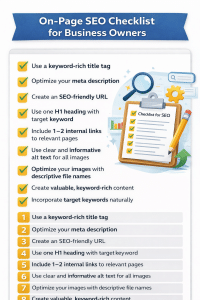
On-page SEO involves many moving parts. Use this checklist to audit any page on your website:
- Title tag includes the primary keyword and stays under 60 characters
- Meta description is unique, under 155 characters, and includes a call to action
- H1 tag contains the primary keyword and appears only once
- Header hierarchy (H2, H3) organizes content logically with relevant keywords
- Content matches the searcher’s intent and covers the topic thoroughly
- Primary keyword appears in the first 100 words and naturally throughout
- Internal links point to and from related pages on your site
- Images have descriptive alt text and are compressed for speed
- URL is short, descriptive, and keyword-relevant
- Page loads quickly on both desktop and mobile devices
Running through this list for every page on your site takes time, especially if your site has dozens or hundreds of pages. That is where a professional team makes the difference.
Big Easy SEO handles on-page optimization for businesses across Louisiana, Texas, California, Colorado, Mississippi, and Washington. Get your free website analysis and let our team handle the details.
Common On-Page SEO Mistakes That Hurt Rankings
Even experienced business owners make on-page SEO errors that hold their sites back. Recognizing these mistakes is the first step toward fixing them.
- Keyword stuffing is still one of the most common problems. Repeating the same phrase over and over does not help your rankings and can actually trigger Google’s spam filters.
- Duplicate title tags and meta descriptions across multiple pages confuse search engines and dilute your ranking potential. Every page needs unique meta elements.
- Thin content that provides little value to readers signals to Google that your page is not worth ranking. Pages with fewer than 300 words or content that simply restates what competitors have already published rarely perform well.
- Ignoring mobile optimization is a costly oversight. Google uses mobile-first indexing, meaning it primarily evaluates the mobile version of your site for ranking purposes.
- Slow page speed drives visitors away before they even see your content. Research shows that pages loading in under two seconds hold user attention significantly better than slower pages.
- Missing alt text on images is a missed opportunity for both SEO and accessibility. Every image should have a descriptive alt attribute.
For a deeper breakdown with solutions for each mistake, read our guide on common on-page SEO mistakes and how to fix them.
Frequently Asked Questions About On-Page SEO
What is the difference between on-page SEO and off-page SEO?
On-page SEO covers optimizations made directly on your website, including content, title tags, headers, internal links, and images. Off-page SEO focuses on external signals like backlinks from other websites, brand mentions, and social media presence. Both work together to determine how your site ranks.
How long does it take for on-page SEO to show results?
Most businesses see measurable improvements in search rankings and organic traffic within four to six months of consistent on-page optimization. Results compound over time as search engines recognize your site’s growing relevance and authority across your target topics.
Can I handle on-page SEO myself?
Business owners can manage basic tasks like writing title tags, adding alt text to images, and publishing quality content. Keyword research, content strategy, competitive analysis, and ongoing technical optimization typically benefit from professional expertise and specialized tools.
How often should I review my on-page SEO?
Plan to audit and update your on-page SEO at least quarterly. Search engine algorithms change regularly, competitors optimize their pages, and your own content can become outdated. Frequent updates keep your pages competitive.
Does on-page SEO affect local search results?
Absolutely. On-page elements like location-specific title tags, locally relevant content, and local SEO schema markup play a direct role in how your business appears in local search results and Google Maps.
What is the single most important on-page SEO factor?
Content quality and topical relevance remain the top-ranked on-page factors. Google prioritizes pages that answer a searcher’s query thoroughly, accurately, and with demonstrable expertise. Without strong content, other on-page optimizations have limited impact.
Is on-page SEO a one-time project?
No. On-page SEO is an ongoing process. Search algorithms update, competitors publish new content, and user behavior shifts. Pages that ranked well six months ago may need refreshed content, updated keywords, or improved structure to maintain their positions.
How does on-page SEO affect visibility in AI search tools?
AI-powered search tools and large language models pull answers from pages that rank well and are clearly structured. Using question-based headings, direct answer paragraphs, FAQ sections with schema markup, and entity-rich content all make it easier for AI systems to understand, cite, and recommend your pages.
Do meta descriptions directly affect Google rankings?
Meta descriptions are not a direct ranking factor. However, a compelling meta description increases your click-through rate from search results, and higher click-through rates send positive engagement signals that can indirectly support your rankings.
How many internal links should each page have?
There is no fixed number, but every page should have at least two to three internal links pointing to related content, and every page should be linked to from at least one other page on your site. The goal is to create clear pathways between topically related pages.