


 Bigeasyseo
How to Make Your Content Appear in AI Search Results


Optimizing content for AI search requires structuring information with clear, direct answers, using question-based headings, and formatting data for easy extraction. Focus on providing complete, standalone answers in the first 40-60 words of each section, maintain consistent terminology, and organize information with lists, tables, and definitions that AI models can easily parse and present to users.
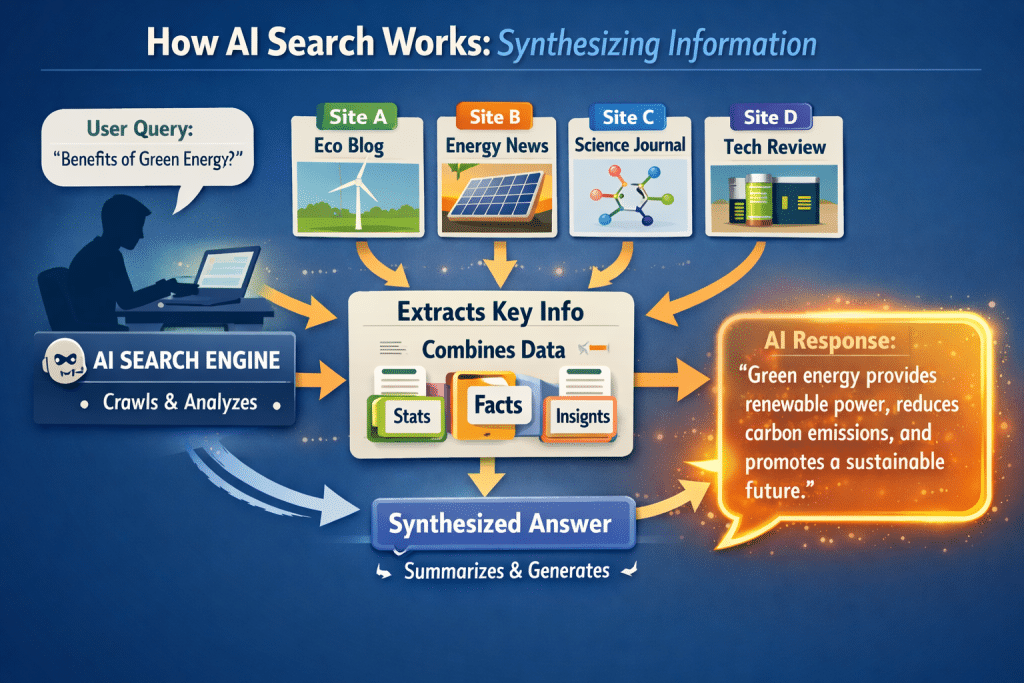
The landscape of online search has transformed dramatically. AI-powered search engines like ChatGPT, Google’s AI Overview, Perplexity, and Bing Chat now generate direct answers instead of just listing links. These systems pull information from websites to create conversational responses, which means your content needs optimization specifically for AI extraction. Business owners who adapt their content strategy for answer engine optimization (AEO) gain significant visibility advantages in this new search environment.
Why AI Search Optimization Matters for Your Business
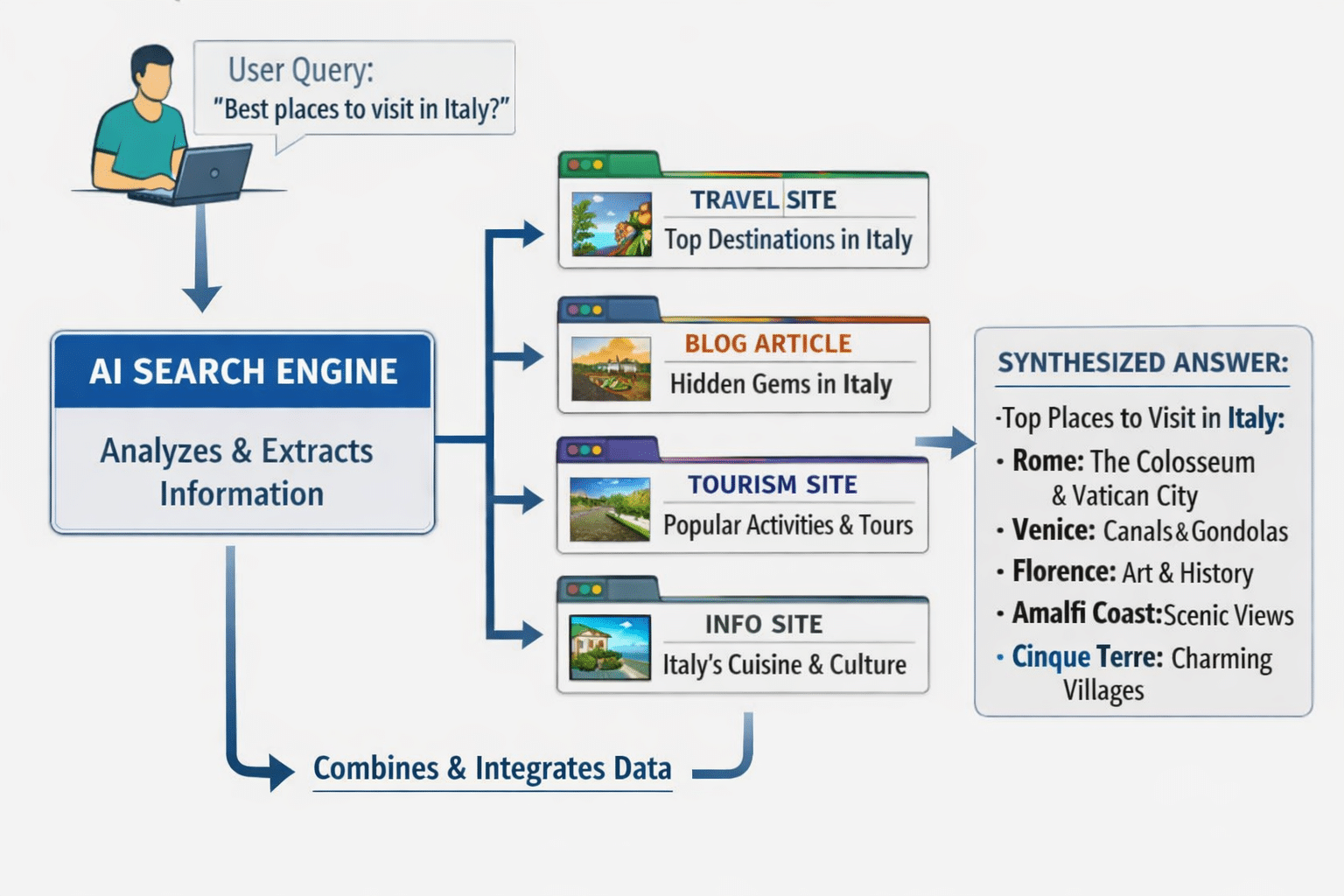
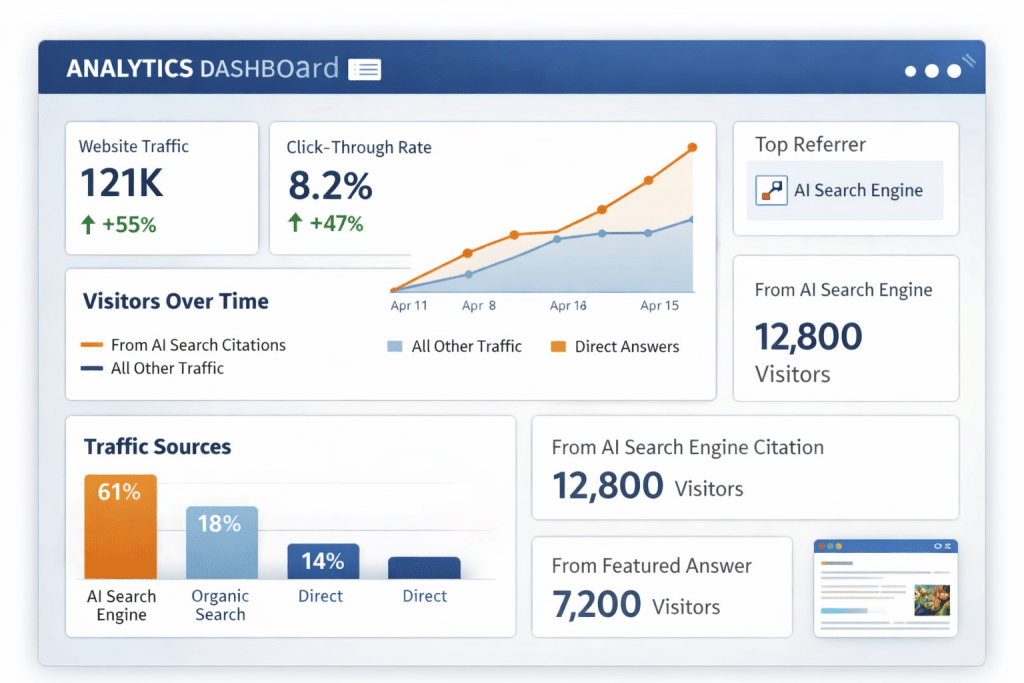
AI search engines analyze and synthesize information from multiple sources to provide users with comprehensive answers. When your content is structured properly, these systems cite your business as a source, driving qualified traffic and establishing authority. Unlike traditional SEO, where users click through search results, AI search often provides complete answers on the results page, making proper optimization the difference between visibility and obscurity.
The shift affects how people discover businesses online. Studies show that conversational AI queries have increased by over 300% since 2022, with users preferring direct answers to sorting through multiple web pages. Your business either becomes the source of AI systems reference or you disappear from these conversations entirely.
Structure Content with Direct Answer Openings
AI models prioritize content that provides immediate, clear answers. Start each major section with a concise 40-60-word paragraph that directly answers the question posed in your heading. This technique ensures AI systems can extract your answer without additional context, increasing the likelihood your business gets cited as the source.
Write these opening paragraphs as standalone statements. They should make complete sense even when pulled entirely out of context. Avoid phrases like “as mentioned above” or “we’ll explore this further” in your answer paragraphs. AI systems often extract these sections verbatim, so clarity and completeness matter significantly.
After providing your direct answer, expand with supporting details, examples, and deeper explanations. This structure serves both AI extraction and human readers who want comprehensive information.
Use Question-Based Headings That Mirror Search Queries
Frame your H2 and H3 headings as questions that people actually ask. Instead of “Content Structure Best Practices,” write “What content structure works best for AI search?” This approach aligns your content with natural language queries that users type into ChatGPT and other conversational search tools.
Research common questions in your industry using tools like Answer the Public, Google’s “People Also Ask” feature, or by analyzing customer inquiries. Each question-based heading should have a corresponding direct answer that AI systems can extract and present to users.
Question headings also improve your content’s performance in traditional search results, featured snippets, and voice search. The alignment between user queries and your heading structure creates multiple optimization benefits from a single strategic decision.
Need help restructuring your website content for maximum AI visibility? Big Easy SEO specializes in on-page optimization that gets your business featured in AI search answers. Call us at (504) 475-2049 to discuss your content strategy.
Format Information for Easy AI Extraction
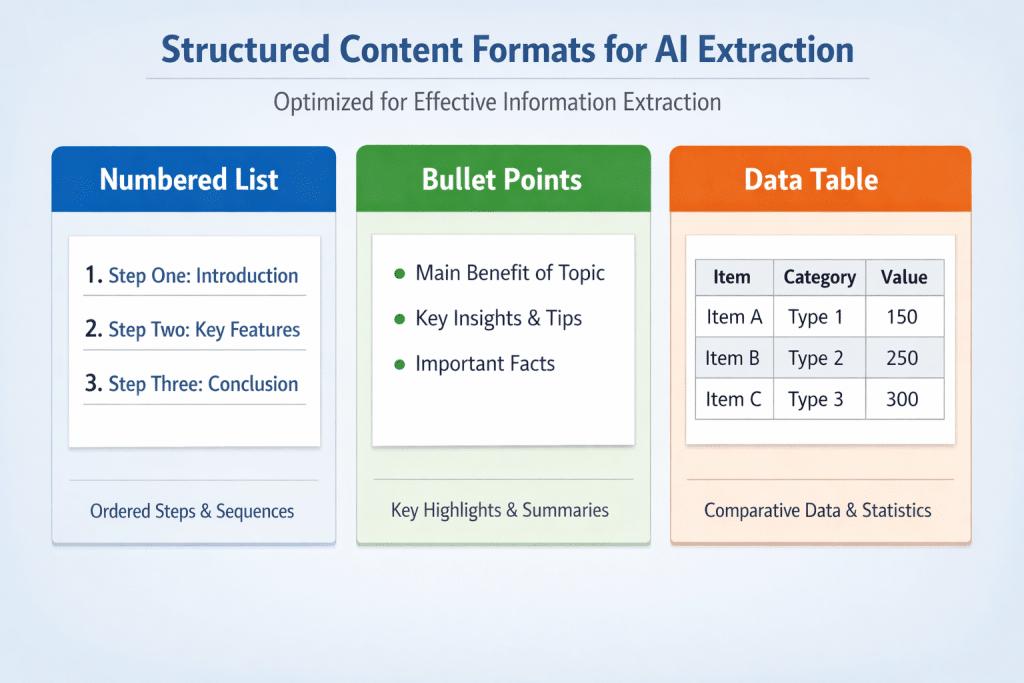
AI models excel at parsing structured data. Organize information using numbered lists for sequential steps, bullet points for features or tips, and tables for comparisons. These formats make content extraction straightforward for AI systems processing your pages.
When presenting steps or processes:
1. Number each step clearly and keep steps concise
2. Include the action verb at the beginning of each step
3. Provide enough detail that the step stands alone
4. Use consistent formatting throughout your numbered lists
For feature lists, benefits, or tips, bullet points work effectively:
– Each bullet should communicate one complete idea
– Start with strong, descriptive words that capture attention
– Keep bullets parallel in structure and length
– Limit lists to 5-8 items for optimal readability
Tables prove particularly effective for comparisons, pricing information, or data that benefits from side-by-side presentation. AI systems can easily extract tabular data and incorporate it into generated answers.
Define Terms and Maintain Consistent Language
AI language models analyze entity relationships and terminology patterns. Define key terms when first introducing them, then use those exact terms consistently throughout your content. Switching between synonyms confuses AI systems and dilutes your content’s relevance signals.
Create clear, simple definitions using subject-verb-object sentence structures. For example: “Answer Engine Optimization (AEO) refers to strategies that make content easily extractable by AI search systems.” This straightforward approach helps AI models understand and categorize your content accurately.
Avoid jargon without explanation, but do use industry-specific terminology when appropriate. AI systems recognize authoritative content through the proper use of technical language combined with clear explanations that demonstrate expertise.
Write at an Accessible Reading Level
- Target an eighth-grade reading level for most business content. AI systems favor content that communicates clearly to broad audiences. Complex sentence structures and advanced vocabulary create barriers to extraction and comprehension.
- Use shorter sentences averaging 15-20 words. Break longer paragraphs into digestible chunks of 3-4 sentences. This approach improves readability for both human visitors and AI processing systems, analyzing your content structure and meaning.
- Active voice strengthens your writing and makes information extraction more reliable. Instead of “Your business can be helped by our services,” write “Our services help your business grow.” Direct, active statements translate better when AI systems synthesize information from your content.
Provide Complete, Authoritative Answers
Vague or incomplete information reduces your chances of AI citation. AI search engines prioritize sources that provide definitive, comprehensive answers backed by expertise. When addressing topics in your industry, demonstrate deep knowledge through specific examples, relevant data, and practical application guidance.
Support claims with verifiable information. While you should avoid inventing statistics, referencing real data points, case studies, or established industry benchmarks strengthens your content’s authority. AI systems assess source credibility when selecting which content to feature in generated answers.
Address related questions within your content. Comprehensive coverage of a topic signals to AI systems that your page serves as a valuable resource worth referencing. This depth increases the likelihood of your content appearing in AI-generated responses across multiple related queries.
Ready to transform your website into an AI-search-friendly resource? Big Easy SEO’s on-page optimization services position your content for maximum visibility in traditional and AI-powered search. Contact us at (504) 475-2049 to get started.
Optimize Your Technical Foundation
Technical SEO elements affect how AI systems access and understand your content. Ensure your website loads quickly, works properly on mobile devices, and presents a clean, accessible HTML structure. AI crawlers follow similar patterns to traditional search bots, so technical excellence supports both optimization approaches.
Schema markup helps AI systems understand your content’s context and structure. Implement appropriate schema types like FAQ, HowTo, Article, or LocalBusiness depending on your content. This structured data provides explicit signals about your information’s meaning and organization.
Create XML sitemaps and maintain a logical site architecture. AI systems crawl and process well-organized websites more effectively than those with confusing navigation or broken link structures. Your technical foundation either facilitates or hinders AI content extraction.
Frequently Asked Questions
How long does it take to see results from AI search optimization?
Most businesses notice improved AI citations within 4-8 weeks after implementing proper content structure and formatting. Results depend on your content’s current state, competition levels, and how frequently AI systems crawl your site. Consistent optimization across multiple pages accelerates visibility improvements.
Do I need different content for AI search versus traditional SEO?
No, the same content can optimize for both when structured correctly. Use question-based headings, direct answer openings, and clear formatting that serves traditional search algorithms and AI extraction systems simultaneously. The techniques complement rather than conflict with each other.
Which AI search engines should I optimize for?
Focus on ChatGPT, Google’s AI Overview, Microsoft Copilot, and Perplexity as the primary AI search platforms. Optimization strategies that work for one generally benefit your visibility across all of them since they use similar content extraction principles.
Can AI search optimization help local businesses?
Absolutely. Local businesses benefit significantly when AI systems cite them for location-specific queries. Combine AEO techniques with local SEO fundamentals like accurate business information, location-specific content, and schema markup to maximize visibility in AI-generated local recommendations.
What types of content perform best in AI search results?
Comprehensive guides, step-by-step tutorials, comparison content, and FAQ pages perform exceptionally well. AI systems favor content that provides complete answers to specific questions, making educational and informational content particularly valuable for visibility.
How often should I update content for AI search optimization?
Review and refresh your high-priority pages quarterly. Update statistics, examples, and best practices to maintain accuracy. Fresh, current content receives preferential treatment from AI systems evaluating which sources to cite in generated answers.
Does word count matter for AI search visibility?
Quality matters more than length, but comprehensive coverage requires sufficient depth. Pages with 800-1,200 words for specific topics and 2,000+ words for comprehensive guides typically perform well. Focus on answering questions thoroughly rather than hitting arbitrary word count targets.